Price Dynamics
Module: hours_eoh/core/prices.py
These functions compute floor prices: the TEH price set by a good's human labor content. As automation rises, floor prices fall, so the floor's purchasing power rises — within the model this follows from its structure, not from policy. Prices above the floor are discovered by exchange and are not modelled here.

teh_price(human_labor_hours_at_eps0, epsilon, …) → float
Floor price of a good in TEH: human labor content × mean multiplier, where human labor content = (1 − ε) × base_hours. A goods price floor keeps some irreducible human contribution, so the price never reaches zero. An optional scarcity_factor from domain_scarcity_multiplier() raises it when demand outruns capacity.
from hours_eoh.core.prices import teh_price

price = teh_price(human_labor_hours_at_eps0=0.1, epsilon=0.40)
basket_price(epsilon, …) → float
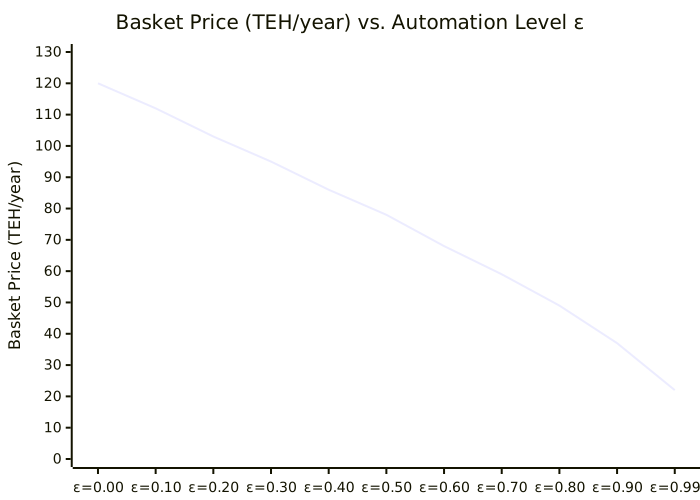
TEH cost of the sufficiency basket at ε. Goods (60% of basket) decline steeply with automation; services (40%) decline more slowly. Both fall, so the floor's purchasing power rises automatically.
purchasing_power(teh_amount, epsilon, …) → dict
Real purchasing power of a given TEH income at ε — how many sufficiency baskets can be purchased.
floor_purchasing_power(floor_teh, epsilon, …) → dict
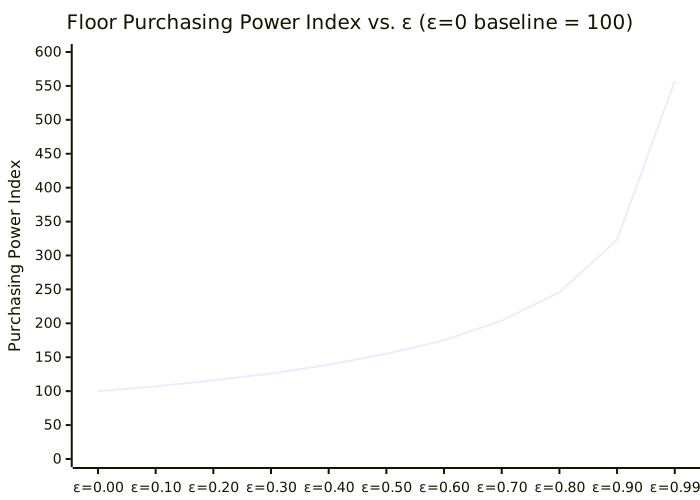
Purchasing power of the sufficiency guarantee floor at ε. Rises monotonically with automation.
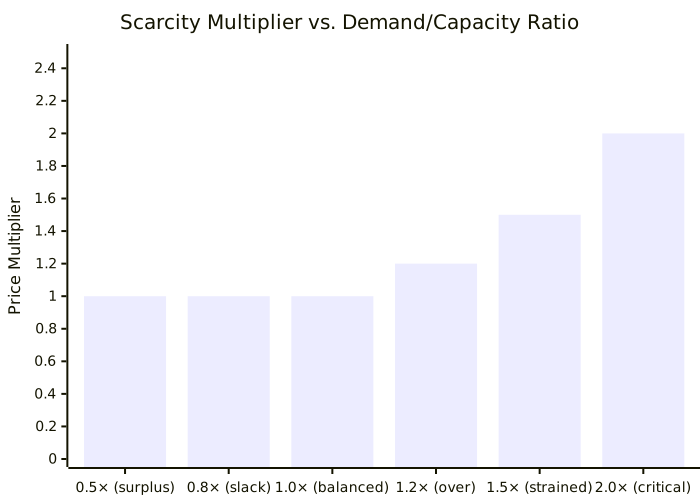
domain_scarcity_multiplier(eoh_demand, fulfillment_capacity, …) → float
The only S/D-like mechanism in the framework. Activates only when EOH demand exceeds fulfillment capacity. Corrective, not foundational — resets once labor is redirected.
Audit and Monotonicity
full_price_monotonicity_audit(…) → dict
Verifies Principle 5 for every price component at once: basket_price() and teh_price() non-increasing in ε, floor purchasing power non-decreasing. Scarcity multipliers are demand-dependent and may legitimately break monotonicity, so they are not checked.
floor_monotonicity_guard(…) → dict
Sweeps ε from 0 to 0.99 and flags any step at which floor purchasing power declines.
cpi_goods_destruction(capital_personal_eoh_fulfilled_total, epsilon, …) → dict
D4 TEH destruction: when capital assets (water treatment, hospitals, energy grids) deliver personal-EOH services, those services are consumed at their embedded labor price and the TEH is destroyed at the point of delivery.
Additional Functions
| Function | Description |
|---|---|
teh_price_trajectory(human_labor_hours_at_eps0, …) |
Price across a range of ε values |
purchasing_power_sweep(teh_amount, …) |
Purchasing power across the arc |
Design Invariant
Basket price must be non-increasing across the full ε arc, and floor purchasing power non-decreasing. The full_price_monotonicity_audit() and floor_monotonicity_guard() functions enforce this. Any mechanism that violates this invariant violates Design Principle 5.